

How Investing in Healthy Schools Pays Off
State of our Schools report reveals eye-opening results on the impact on kids.
“We shape our buildings and afterwards our buildings shape us.” – Winston Churchill
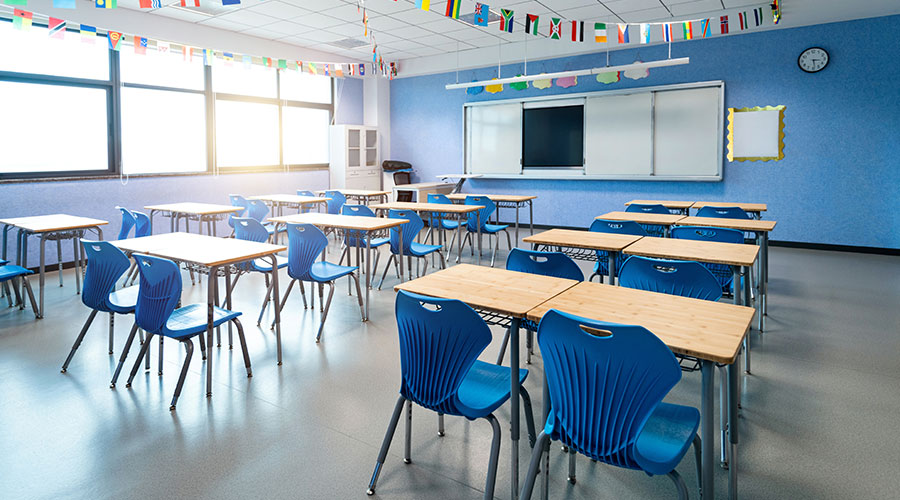
Churchill’s quote applies very well to school facilities, which form the environment in which children are taught and nurtured, and through which they in turn shape our future. So why isn’t the physical condition of our school buildings taken more seriously? Whether these facilities are healthy and positive learning environments – or not – will reverberate for many years in students’ lives as well as in the world they shall inherit.
K-12 school facilities have been demonstrated to be strong influences on students’ health and success. Kids’ sensitive, developing lungs and immune systems bear the brunt of unhealthy indoor environments – where they may be packed as much as four times more densely than a typical office space.
Asthma is a major problem among American children and many key asthma triggers are impacted by the condition of school facilities. These include mold and moisture, dust, pests, combustion byproducts and strong chemicals, whether in school laboratories or from building products like paint and cleaning solutions.
4.5 million U.S. children had asthma in 2022, totaling about 1 in every 16 kids – with a much higher prevalence among minorities. Asthma is the third-leading cause of hospitalization among children and it results in approximately 13.8 million missed school days per year. Those absences can lead to serious gaps in learning.
Poor indoor air can also directly impact student learning. High carbon dioxide levels not only lead to foggy thinking and such symptoms as headaches but have been linked to lower test scores.
Everyone from parents to teachers to local leaders should care about this situation, but facility managers or building engineers are in a strong position to do something about it.
Investing in a healthier environment
First, having the facts and figures at the ready can equip you to fight for adequate budgets to help keep the kids and adults in your care safe, healthy and performing.
It’s no big secret that public school budgets are often inadequate, but a recent national report, the 2025 State of Our Schools, produced by the 21st Century School Fund and several partner organizations, quantified that shortfall in detail. The report estimates that school facilities budgets are underfunded by $90 billion, about twice as much as the gap measured a decade ago.
Altogether, U.S. public K-12 schools constitute over 8 billion square feet of facilities that are, on average, about 40 years old. As the report notes, “it is not unusual to find public schools without air conditioning, mechanical ventilation, or air filtration.” As average temperatures rise with climate trends, outdated HVAC systems become an even bigger problem.
While curing the national budget shortfall is a larger discussion, local school districts are where many of the critical funding decisions are made. And here is where the case for not shortchanging our kids will have the greatest impact.
What leading districts are doing
While HVAC upgrades are often needed – and proper maintenance of these systems is always essential – there are many other actions school facility managers and administrators can take to create healthier classroom environments. One strategy that is well suited for schools is green cleaning, i.e., using cleaning products without harmful chemicals.
While cleaning products must be effective enough to thwart mold, dust and dirt and ward off pests, they should not be so potent as to irritate children’s sensitive respiratory systems. A number of states require school green cleaning policies and practices.
At the local level, the Clarke County, Georgia, School District has maintained a green cleaning program in all 24 of its schools for the past 15 years. The Wellesley, Massachusetts, schools have also had a long-time green cleaning program that not only includes purchasing green labelled products but also the innovation of producing its own disinfectant and sanitizer on-site in each school.
Pesticides are another potential source of toxicity, making integrated pest management (IPM) programs that employ smart techniques to keep pests out (like filling cracks and creating physical barriers to block them) another critical strategy. The Davis School District in the suburbs of Salt Lake City, Utah, employed IPM so successfully that it was able to eliminate almost all of its pesticide use.
While indoor air quality (IAQ) monitors used to be too expensive for a school district to consider purchasing, costs have come down, making their use feasible to gather data on indoor environmental parameters and guide facility responses more strategically. Boston Public Schools are leading the way with a network of 4,400 indoor and 118 rooftop sensors to capture real time IAQ data.
The facility management tasks this data have been used to inform include adjusting temperatures and ventilation in real-time; identifying and fixing mechanical issues, such as blocked vents or closed dampers; enforcing pollutant reduction strategies like anti-idling policies; and supporting budget plans and proposals for HVAC upgrades.
A number of national programs focus on systematically equipping schools to turn their facilities into healthier environments, including:
- US EPA’s Tools for Schools, which provides a range of free guidance and tools to help administrators and staff improve facility IAQ.
- Healthy Green Schools and Colleges, an NGO that provides a healthy school standard and certifies facilities that meet it.
- The International WELL Building Institute (IWBI) WELL Building Standard, a comprehensive resource and certification program used by a range of K-12 school districts.
The question of how much and how well to invest in our children’s learning environments is a consequential one. The bottom line comes down to a lot more than dollars and cents. A diminished school experience based on too many health-related absences, a poor, distracting environment, moldy smells, stale air, etc. will reverberate far into the future of the children trying to navigate this environment. We should do our part to help ensure that their time in school is a healthy, beneficial experience, not a harmful ordeal.
By Ken Sandler, Facility Influencer
Ken Sandler, Ph.D., is a clean energy and sustainability analyst and thought leader who spent 35 years advancing green building and sustainability policies and programs across the federal government. In addition to being a Building Operating Management Facility Influencer, he writes his own newsletter, Regenerative Insights, available on LinkedIn and Substack.
The post "How Investing in Healthy Schools Pays Off" appeared first on Building Operating & Management