


Greece Aims for $577M Crete Airport to Serve as a Regional Hub
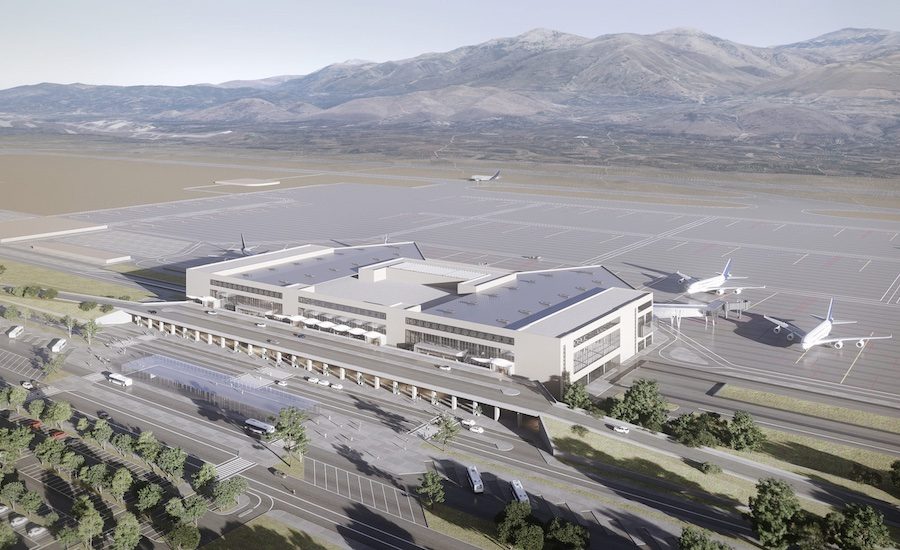
Completion of a new airport in on the Greek island of Crete has been pushed back to 2028, but transportation officials say they are laying the groundwork for what eventually be a major regional transportation hub in the eastern Mediterranean.
The new opening date for the Heraklion International Airport (HIA) at Kasteli in central Crete is to ensure all digital and safety systems are fully integrated before the project opens, project officials say.
With a project valuation of €500 million ($577 million), the Kasteli airport is one of the largest infrastructure projects in Greece. The new airport will replace the aging Nikos Kazantzakis airport located near the city of Heraklion, and will serve up to 11 million passengers annually, Gianni Smaragdakis, construction coordinator and public relations manager for the project, confirmed to ENR.
“We will begin with 11 million and try to get up to 15 million quickly,” Smaragdakis said. “We want the airport to be busy.” The master plan provides an option to expand passenger capacity to 18 million people.
Construction, led by contractor TERNA S.A., began earlier this decade and is now 67% complete, Smaragdakis confirmed.
The project is being overseen by the special purpose entity, International Airport Heraklion Crete Concession S.A. Its task is to design, construct, finance, operate and maintain the new airport under a 35-year concession ratified by Greek law. The company is also to design, construct and finance connecting roads that access the airport.
The Hellenic Republic holds 45.9% of the concession, Greek construction giant GEK TERNA Kasteli S.M.S.A. holds 32.5%, and GMR Airports Greece S.M.S.A. holds 21.6%.
The airport is being constructed to meet ICAO Class 4E standards, which will enable it to serve large, long-haul aircraft such as the Airbus A350 and Boeing 777. The 3,200-meter runway is designed for high-capacity international traffic, with an option to build it out to 3,800m in the future. There will be one main parallel taxiway of equal length, eight rapid-exit taxiways, and two crossfield taxiways that will connect with an adjacent Greek military airbase.
A parking apron will accommodate 27 remote stands and up to 10 fixed contact stands. The control tower will be seven levels standing 44 m tall and be equipped with state-of-the-art, fully digital navigation equipment and air traffic management systems.
The 93,000-sq-m terminal is structurally complete and indoor mechanical systems are currently being installed.
In February, a tender for the airport’s air navigation systems was opened following the signing of an air navigations equipment agreement between HIA and the Greek Ministry of Infrastructure and Transport in late January. Seen as a key step towards certification and future operation, the tender covers design, equipment supply and installation, testing, integration and maintenance of the airport’s aeronautical systems. The tender also covers communication, navigation and surveillance systems.
The Kasteli airport will take over the role of the old airport which is to set to be decommissioned. “Kazantzakis airport will work up until the day Kasteli opens,” Smaragdakis said.
Kazantzakis airport, named after famed Greek author Nikos Kazantzakis, has seen passenger numbers jump in recent years to serve some 100 airlines with 160 destinations in Europe, Asia and Africa. The Kasteli project is currently the only new airport planned or under construction in the eastern Mediterranean, and the goal is to eventually grow it into a regional transportation hub. Smaragdakis said that that is not the primary focus of the airport project right now, but it is being build so it could grow into that role.
The new airport is expected to have a big economic impact on the island of Crete, with the creation of 7,500 permanent jobs and the expectation that it will spur further private construction in nearby urban areas.
The post "Greece Aims for $577M Crete Airport to Serve as a Regional Hub" appeared first on Consulting-Specifying Engineer