

Boston’s Matthews Arena Set for Complete Redevelopment
Northeastern University is moving forward on a complete redevelopment of Boston’s 105-year-old Matthews Arena. Proposals don’t stop there, though, with new dorms coming to the campus as part of a larger infrastructure plan.
“It will be transformational,” Ken Henderson, school chancellor and senior vice president for learning, says about the multi-purpose athletics and recreation complex coming to the site of Matthews Arena.
The original home of the Boston Bruins and Boston Celtics—it first opened in 1910, but a fire destroyed it in 1918, and the arena was rebuilt in 1920—is now the world’s oldest multi-purpose athletic building still in use and the oldest ice hockey arena. It will get replaced by a 310,000-sq-ft complex across the entire two-acre footprint (including areas currently surface parking lots) to host ice hockey and basketball for Northeastern, along with recreational opportunity for staff and as a home for community events.
“We love Matthews Arena, but it is a single-use space,” Henderson says. “The new complex will have multiple events and activities going on at the same time. You could be having a hockey game at the same time as you’re having a club soccer game on the floor above—and perhaps a varsity basketball practice is being held, while other students are lifting weights and doing cardiovascular training at an individual level.”
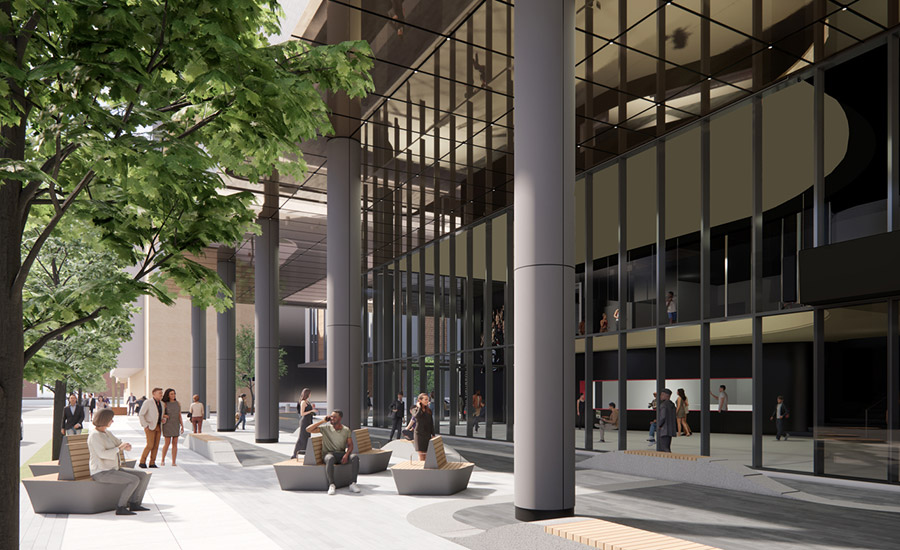
Designed to support Division 1 athletics, club teams and intramural sports, the arena will seat 5,300 for basketball, 4,050 for hockey and can host more than 5,600 for graduation.
While the current arena is significant, it doesn’t boast legal historical status thanks to a major 1950s renovation. Still, design plans from Perkins & Will and Dream Collaborative call for saving the 1920s terracotta arch currently located at the entrance of the arena and reusing it as a showpiece in the new venue’s lobby.
Sean Edwards, executive vice president and division manager for Suffolk, the project contractor, tells ENR that one of the most meaningful aspects of the work is the careful preservation of the building’s historical character and the terracotta arch. “Our team is salvaging the arch prior to demolition, storing it safely and ultimately reinstalling it as a signature element at the main entrance of the new building,” he says. “We also used laser scanning on both the existing building and the arch. This allowed us to capture precise as-built geometry so that if any terracotta pieces were to break, we could recreate them accurately from the 3D scan.”
The site will present unique challenges, forcing the team to work in a tight footprint bordered by rail lines and residents.
Quinn Valchich, senior project manager for Boston’s planning department, says the planning department’s board approved the redevelopment of the arena on Nov. 13 and the zoning commission will next vote on the school’s larger Institutional Master Plan (IMP) on Dec. 10, a necessary hurdle for the arena project to move forward.
As part of the larger IMP, the school and the city agreed to a PILOT (Payment-in-Lieu-of-Taxes) plan that includes housing commitments for the community around Northeastern. The IMP features $62.5 million in community benefits during the next 10 years, $16.5 million in community benefits and $6 million in linkage associated with the arena and more than $49 million in cash and community benefits during the next five years.
Part of that includes the pursuit of eight new on-campus student housing projects during the next 10 years. Already, a new 1,215-bed residential tower broke ground in August at 840 Columbus Ave. Under the IMP, Northeastern will contribute $10 million during the next 10 years to help stabilizing the city’s housing.
“Northeastern’s Institutional Master Plan represents a balanced approach that allows the university to invest in its institutional growth with a renewed commitment to housing stabilization for the surrounding communities,” says Kairos Shen, Boston’s chief of planning.
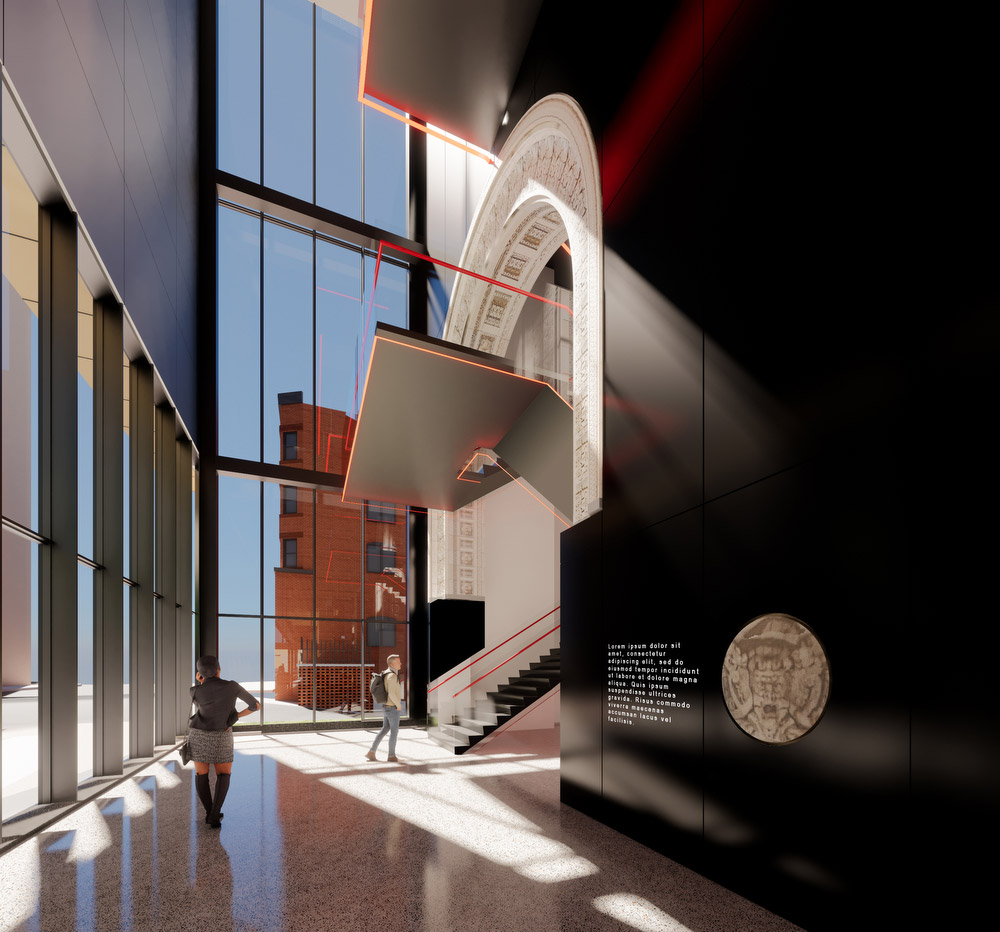
Design plans from Perkins & Will and Dream Collaborative call for saving the 1920s terra cotta arch currently located at the entrance of the arena and reusing it as a showpiece in the new venue’s lobby.
The PILOT program places a focus on cash for the city. “Our five-year PILOT agreement sets a new standard for higher annual cash payments and community benefits at a time when Boston taxpayers need relief,” Michelle Wu, Boston’s mayor, said in a statement.
Next on the list is the redevelopment of the arena. Designed to support Division 1 athletics, club teams and intramural sports, it will seat 5,300 for basketball, 4,050 for hockey and can host over 5,600 for graduation. Both the men’s and women’s basketball teams will have a practice court, a boon to recruiting, says Jim Madigan, Northeastern’s athletic director, and improved training facilities and office spaces all come part of the space.
For fans, the new arena will offer concessions and multiple entry and exit points. “This is a complex that will be bringing people together,” Madigan says. “It’s going to create a sense of community, a sense of belonging throughout the university.”
Perkins & Will says the “facility is uniquely crafted to fit within its dense urban setting, stacking programs vertically to maximize space and promote synergies.”
The university is aiming to be the first building of its kind to achieve Living Building Challenge CORE and Zero Carbon certification, which will require the use of fully electric equipment, such as hoists and tower cranes. They expect to be an all-electric, fossil fuel-free building that will feature a hybrid ground source and air source heat pump system with 46 geo-exchange wells drilled more than 800 ft deep. Plans include a rooftop solar array on a mass timber roof and a 100,000-gallon cistern to collect rainwater for ice-making, irrigation and greywater use. Deconstruction of the current arena will capture reclaimed materials.
“Balancing historical preservation, a constrained site and ambitious sustainability goals requires rigorous planning and collaboration,” Edwards says.
The school says it will have a timeline for deconstruction and construction once final approvals are granted by the city.
The post "Boston’s Matthews Arena Set for Complete Redevelopment" appeared first on Consulting-Specifying Engineer