

Case Study: Improving Cafeteria Attendance
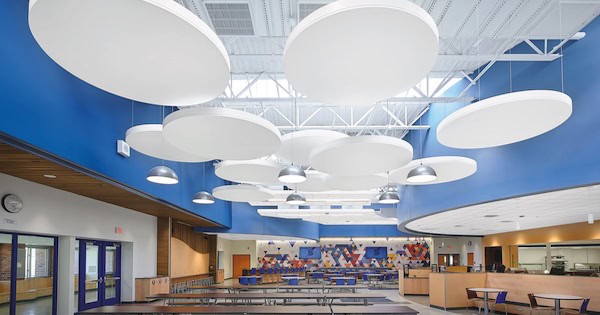
When many people think about how a school cafeteria supports the health of its students, the first things that typically come to mind are the menu offerings and the level of accessibility students have to nutritious meal and snack options. Rarely do the cafeteria’s ceilings and walls find their way into the conversation. However, as this project feature demonstrates, choosing the right ceiling and wall solutions—ones that support everything from improved acoustics and lighting to a more welcoming and spirited atmosphere—very much plays a role in the well-being of students.
In 2022, years prior to its award-winning renovation, Saratoga Springs High School converted its gymnasium into a cafeteria as part of a larger capital project that included the addition of a new gymnasium and converting the previous cafeteria into a guidance suite. However, the converted gym fell short of working properly as a cafeteria. A raised seating platform was awkward and divided students, the serving line was inefficient, and the noise level made it impossible for students to carry on a conversation. When the district embarked on a comprehensive educational plan, feedback about the high school cafeteria was overwhelmingly negative. The Saratoga Springs community felt strongly that renovation of the high school cafeteria needed to be prioritized. Their vision was a welcoming space that fostered school spirit, infused collegiate sophistication, and encouraged elevated levels of interactivity.
One of the greatest challenges of the gymnasium-turned-cafeteria was that it still felt and sounded like a gym. While the acoustics of 500 students occupying the vast space may have offered the appropriate level of “sound energy” for a gymnasium experience, they were far removed from requirements for a healthy, attractive cafeteria setting. In addition, the cafeteria had inefficient use of space, traditional serving lines that didn’t allow students to circulate quickly, and no consideration for COVID-influenced changes that redefined comfort levels for students in large-group settings.
Out Of The Classroom And Back To The “Café”
A significant priority for Saratoga Springs High School leadership was to create a functional and welcoming environment that supported student well-being. Because some students felt the existing cafeteria was overwhelming, they chose to eat in classrooms instead. School leadership looked to transform the cafeteria into a place where students would be excited to return and reestablish social connectivity lost during the pandemic. The architect, Mosaic Associates, encountered a list of challenges that included: significantly reducing noise in a vast 7,810-square-foot space; facilitating traffic flow for up to 500 students in a lunch period; achieving a cohesive look with the corridor; and elevating school branding to a collegiate look. Moreover, the cafeteria needed to create spaces that met the diverse desires of students—from those wanting a quiet dining experience to those looking to eat with small, medium, or large groups—without creating physical barriers. Lastly, this needed to be achieved on a public-school budget.
Serving Up Success
Mosaic teamed up with Armstrong World Industries to determine and provide ceiling and wall solutions that would best fit this new cafeteria. The two companies took three main approaches to the cafeteria design. First, tapping into Armstrong’s diverse product portfolio allowed different ceiling panels to define different pockets within the cafeteria. Secondly, all ceiling panel choices incorporated acoustical sound absorption and/or blocking. In addition, acoustical consultation and recommendations from AVL Designs Inc. were also integral to the space development. Lastly, budget was maintained by utilizing a complimentary design and pre-construction service offered by Armstrong. This helped to ensure efficiency and offset custom components with cost-effective standard solutions.
Highlights of product selection and use are as follows:
- Classic wood ceiling panels with acoustical infill provide a warm, natural visual for the perimeter of the cafeteria.
- Classic custom wood wall panels create a welcoming space for quiet, individual seating; custom manufacturing allows for a sense of movement, and custom-color backer coordinates with background.
- Linear acoustical ceiling panels set off central seating for small groups, provide sound absorption, and allow illumination with integrated lighting and natural light from skylights
- Seamless acoustical ceiling clouds distinguish large-group seating areas with circular clouds offering strong acoustical performance. Clouds are also spaced to allow skylight lighting.
- Additional ceiling clouds define long-table seating areas with rectangular clouds that provide strong acoustical performance and allow skylight lighting.
- Geometric ceiling panels extend the triangle mosaic from the cafeteria into the 2,000 sq.ft. corridor with some custom colors and provide strong acoustical performance (NRC 0.80/CAC up to 35).
- High-performance mineral fiber ceiling panels offer acoustical control, durability, and sustainability provide a clean look over food service areas.
Because this project entailed so many different products and required precise installation to achieve everything from balanced geometric patterns to clean lines from blades to an influx of natural light, the design and pre-construction service played a significant role across the board. The Armstrong team collaborated early and continuously with both the architect and contractor to help ensure the design intent was met, as well as to offer custom solutions–which proved especially beneficial for assuring precise alignment in the ceiling-to-wall transition of solid wood panels. These collaborations also resulted in a high level of detail that increased project efficiency, enabled a smooth installation, and supported design precision.
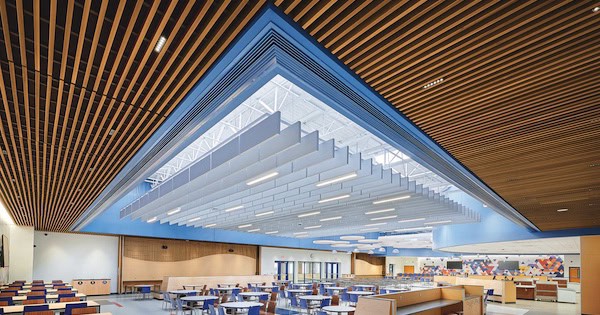
The Saratoga Springs cafeteria demonstrates the value of bringing together the best of digitally assisted design with personal attention necessary for customization. It was designed digitally first to identify and troubleshoot issues before anything reached the point of installation.
According to the general contractor, Hoosick Valley Contractors, teamwork, attention to detail, and responsiveness supported a smooth installation. “A project like this had some tricky components, but everything we received—all the parts and pieces—were well detailed,” said Anthony Cerone, Vice President of Preconstruction, Hoosick Valley Contractors. “Even the wood ceilings and walls installed more easily compared to how we thought it would be.”
“It was extremely helpful to have people to reach out to who knew this project from the start, provided technical insights you can’t get from data sheets, and identified potential pitfalls before things got to the field,” said Amanda Vottis, Architectural Designer, Mosaic Associates. “Great teamwork brought the community’s vision to life.”
The acoustics in the cafeteria are among the first and most frequently commented on attributes, generating “disbelief” at the ability to have normal conversations while hundreds of students occupy the space.
“Our high school cafeteria has been transformed into a vibrant and inviting space, resulting in a 15% increase in lunchtime participation and offering students a more efficient and enjoyable dining experience,” said Maura Manny, Saratoga Springs Director of Community Outreach and Communications. “This renovation enhances the aesthetic appeal and supports our ongoing efforts to promote healthy eating and foster a positive school atmosphere.”
A Winning Transformation
After opening the renovated cafeteria in January 2024, the Saratoga Springs School District reported a near immediate 15% increase in lunch participation, which approached 70% by the start of the 2024-2025 school year. The new cafeteria also earned a spot in the 2025 Foodservice Consultants Society International Project Showcase. The award program recognizes outstanding food service and hospitality design projects exemplifying excellence in innovation, sustainability, functionality, and design execution.
“The transformation of the high school cafeteria has been amazing,” said Dr. Michael Patton, Superintendent of Schools, Saratoga Springs School District. “The improved acoustics have not only created a more comfortable and inviting space for students and staff, but they have also significantly reduced noise levels, fostering a better environment for connection during school meals.”
By Daniel Holdridge
From the August 2025 Issue of Facility Executive
Holdridge is the Senior Manager of ProjectWorks Design and Specialty Solutions at Armstrong World Industries where he leads a team of design engineers, analysts, and technicians who provide custom and boutique design services that help architects transform their ideas into buildable, achievable solutions.
Do you have a comment? Share your thoughts by sending an e-mail to the Editor at [email protected].