

Mississippi River Bridge Implosion Clears Way for New Iowa-Wisconsin Crossing
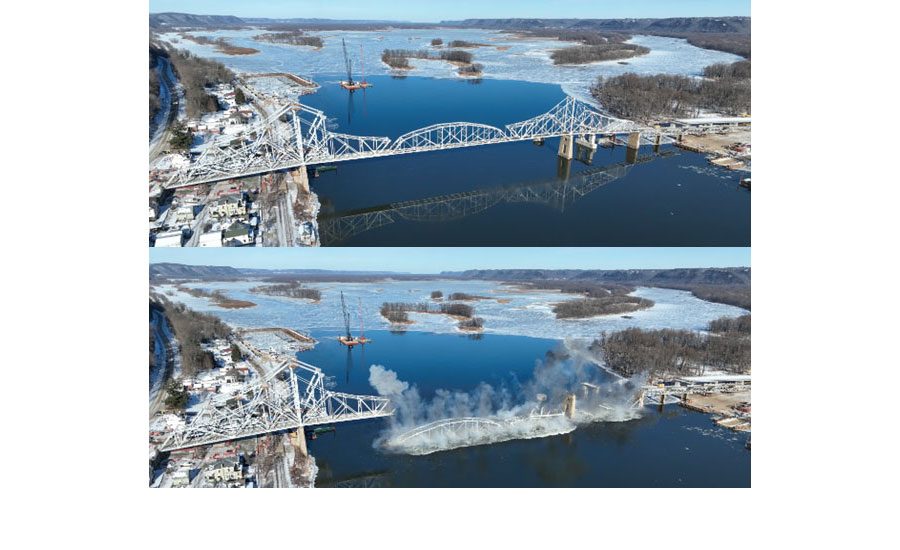
The December holidays arrived with a bang in northeast Iowa, as a controlled demolition process brought down major sections of the nearly century-old Lansing Bridge.
Performed on Dec. 19, the implosion sent the center and Wisconsin-side spans of the steel through truss structure tumbling into the frigid Mississippi River. The remaining sections, which span over residential homes and an active freight line on the Iowa side, will be removed piecemeal by Kraemer North America, which is constructing a new, wider 1,724-ft-long crossing less than 100 ft away from the old bridge.
As the only crossing along a 70-mile stretch of the Mississippi River, the narrow 1,702-ft-long bridge, also known as Black Hawk Bridge, was originally planned to remain in service until the $140-million replacement was complete. Repeated excessive movement of the old structure beyond safety thresholds forced extended closures and complicated Kraemer’s construction schedule, adding several months to the target October 2026 completion date.
Rather than risk further disruption to construction, and to safeguard motorists, the Iowa and Wisconsin Depts. of Transportation, which co-manage the Lansing Bridge, elected to permanently close the crossing this past October. Demolition was advanced to winter, when the ice-choked Mississippi River would be closed to barge traffic.
Kraemer senior project manager Aaron Rosenbery says the revised schedule required compressing more than a year’s worth of demolition planning into the space of a few months. The effort involved extensive coordination and permitting with multiple state and federal agencies, meetings with law enforcement to ensure public safety and dry runs of the process. Final preparations, including pre-cutting structural components for explosives, were further complicated by weather, as an advancing cold front brought rain, snow squalls, high winds and a 30° overnight drop in temperature.
“The following morning, we had re-check things to make sure there were no there no effects from the flash freeze,” Rosenbery says. “Once everything was in place and ready, the blast itself was pretty flawless.”
As planned, the implosion left one short approach span on the Wisconsin side standing as part of a collaboration with Purdue University researchers to test structural redundance of fracture-critical members. Loading the section with 150,000 lb of sand and an array of sensors, researchers planned to compare how well the team’s predictive models matched actual performance by using a shaped charge to cut a critical tension diagonal.
According to Purdue civil engineering professor Robert Connor, the section performed far better than expected.
“Nothing happened,” he says of the small explosion. Indeed, it took cutting three additional primary tension members with excavator-mounted shear attachment before the section finally collapsed.
Along with demonstrating the actual structural redundancy of older steel bridges, a factor Connor says wasn’t considered when they were designed, “the test provides incredibly valuable data that we can use to calibrate our models, and give us greater confidence in our analysis of how a bridge will behave if a fracture-critical member fails. And we’ve found that in many cases, these members are better than we give them credit for.”
With the old bridge literally and figuratively out of the way, Rosenbery says steel erection for the new bridge will proceed on pace into the summer, with the 334-ft-long center section scheduled to be hoisted up using span jacks in July.
“The only uncertainty will be the spring floods, and their effect on our waterborne operations,” he says, adding that the project is now set for completion in Spring 2027.
The post "Mississippi River Bridge Implosion Clears Way for New Iowa-Wisconsin Crossing" appeared first on Consulting-Specifying Engineer