

San Diego International Airport Aims High Structurally, Sustainably and Aesthetically
A decade ago, crews squeezed construction of San Diego County Regional Airport Authority’s $1-billion Green Build program—including a 445,000-sq-ft expansion of Terminal 2, two 17,000-sq-ft curbside ticket lobbies, an elevated departure roadway, six overpasses, and parking lots—into a 661-acre footprint while operations continued at the nation’s busiest single-runway airport.
The sequel, its New Terminal 1, is even bigger, and draws on lessons learned from that previous experience. San Diego International Airport (SAN) is undergoing a $3.8-billion program to replace the 1960s-era Terminal 1 and build a 5,200-space parking plaza, some 4 miles of a baggage handling system and a 5-mile on-airport road system. Last fall, crews, led by the joint venture of Turner and FlatironDragados completed the first 19 gates and 940,000 sq ft of the new terminal, with the total 1.2 million sq ft and 30 gates slated to open in 2028.
“The primary thread has been the delivery method,” says Steve McCabe, vice president with AECOM, which provides program management services for SAN. “I’ve been here since 2006; we did the first progressive design-build project in 2010 on Green Build. With every major project since, we refined the delivery principles.”
This time around, SAN is utilizing program definition documents, drones, a buckling restrained braced (BRB) system and a revamped approach to a centralized project system, provided by PMWEB, to cut progress invoice cycle times in half and maintain real-time visibility across all projects, says Bob Bolton, SAN director of design and construction.
The program definition documents, introduced by AECOM, include the input of various design and construction stakeholders from civil, structural, architectural and mechanical-electric-plumbing fields, Bolton adds. “After defining program needs, we can put a better price on it … and establish a guaranteed maximum price,” he says. “It’s like jet fuel for the program—we start out slow, do the programming and then go fast.”
The validation process took approximately a year. “Geotechnical, sustainability, etc.—we had 75 studies to complete,” says Lori Ann Stevens, vice president and technical design director at Turner. “We spent a year drawing, designing and vetting. By the end of that validation, we knew we had a design to build to.”
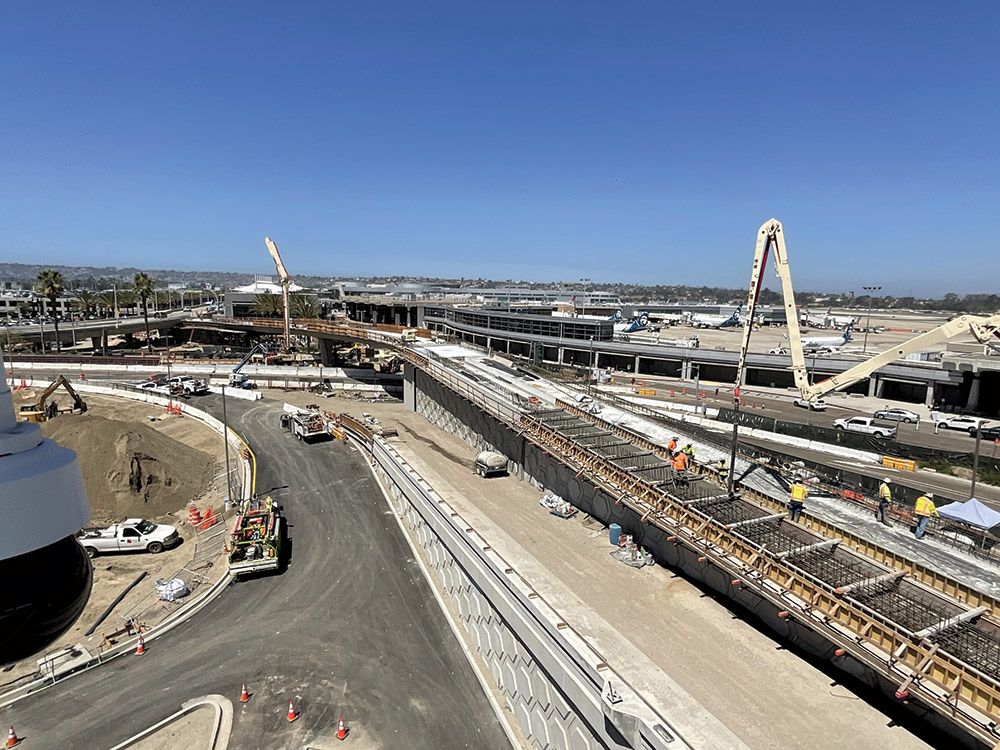
The hemmed-in airport is located on just 663 acres, making staging of projects a logistical challenge.
Photo courtesy Griffith Co.
Digging In
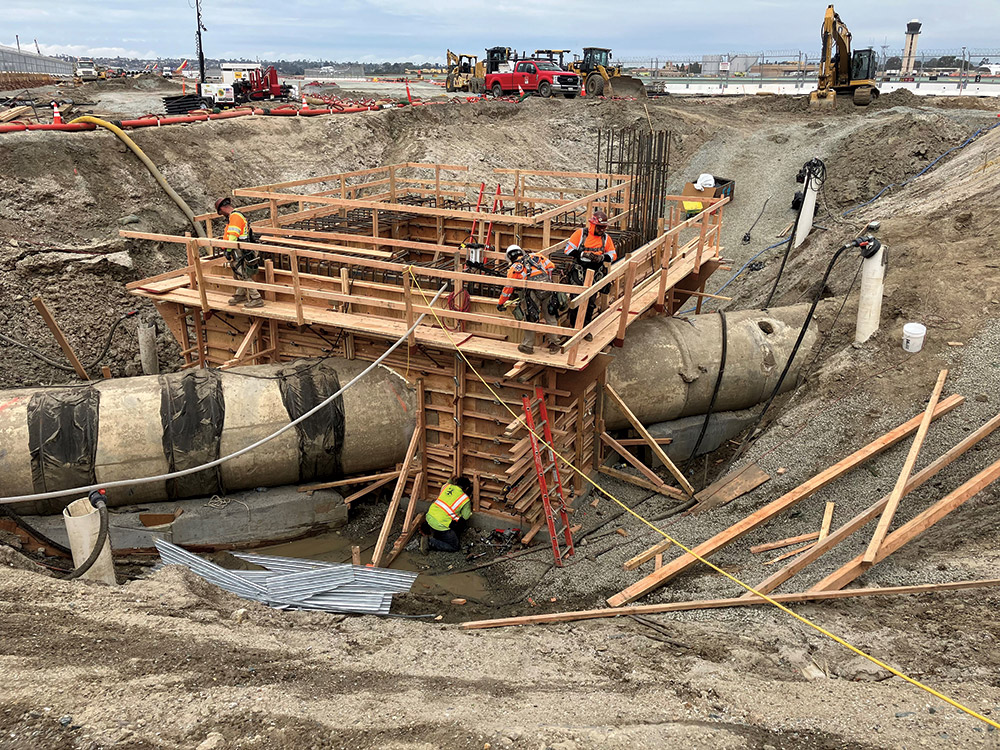 Photo courtesy Griffith Co.
The team soldiered on with that design process through the pandemic while assembling subs and suppliers. The Turner-FlatironDragados team grew from 25 to around 200, with crews on site reaching a peak of almost 1,800 in 2024, says Paul Costa, Turner vice president and project director. “It was daunting knowing we had to not only build a project, but a team.”
With space at a premium, a detailed staging and logistics plan for the road and bridge work was key, says Josh Gilbreath, FlatironDragados landside project manager. “It took a lot of effort, coordination with stakeholders and staying flexible throughout the process.
The pandemic compelled the team to work virtually through that process, notes Matt Semic, CEO and president of Latitude 33 Planning & Engineering. “We started using virtual tools for reviews” of thousands of plan sheets and local agency permits. “We used Bluebeam to maximum capacity.”
Utility relocations occurred early on while design progressed. They included utilities crucial to airport operations, such as for the air traffic control tower, and moving from an old administration building to a new one, notes Costa. The team also migrated systems from the old terminal to the new T1 portion overnight. “There was no impact on operations, and we never affected a flight,” Costa says. Crews also installed some 10 miles of new water, sewer and stormwater utilities.
The old terminal is being demolished to make room for building the rest of the new T1. Overall, 15 buildings had to be demolished, says Semic. “We needed to maintain operations while unpacking 75 years of a spaghetti bowl of utilities,” he adds. “We spent six to eight months identifying them.”
The teams building both airside and landside must deal with hydraulically filled reclaimed land abutting San Diego Bay, which results in shallow groundwater and loose and liquefiable soil conditions. “Fills aren’t great soils for supporting structures,” says Janna Bonfiglio, geotechnical group manager with Kleinfelder, the landside civil and geotechnical engineer, which performed 96 borings and cone penetrometer tests up to 160 ft deep. “Below the fill are natural bay deposits—liquefiable materials.” The airport is located near the Rose Canyon Fault Zone.
“The airport runs west to east; the further east you go, the deeper the bay deposits get,” she adds. The retaining walls on the east could potentially have settled as much as 6 in., and were closely monitored.
“The airport is essentially a bathtub,” explains Semic. “You go down six or seven feet, and you hit groundwater. [Crews] constantly had to pump it out.”
The terminal’s total of nearly 3,000 auger-cast-in-place piles have 18 in. dia and depths of up to 90 ft. The bridge structures, including a new elevated departures roadway, have cast-in-drilled-hole piles as large as 10 ft in dia and as deep as 140 ft. The 30+ retaining walls required ground improvement treatment methods of deep soil mixing and jet grouting to mitigate the potential for seismic slope instability.
The new roadway system diverts thousands of vehicles from North Harbor Drive and its cross streets, pedestrians and signals, says Jim Frost, Kleinfelder landside civil design lead. Semic adds: “The front door to the airport previously consisted of city streets with multiple entrances…. Now Harbor Drive is returned to the waterfront.”
A new trail system, approximately 3 miles long and adorned with uplit palm trees, connects the airport to downtown San Diego, says Semic.
With some 5 acres of pedestrian paths, almost 20 acres of landscaping, 25 acres of roadway system and 21 acres of new terminal and parking plaza, “we got a lot packed into this postage-stamp airport,” Frost says.
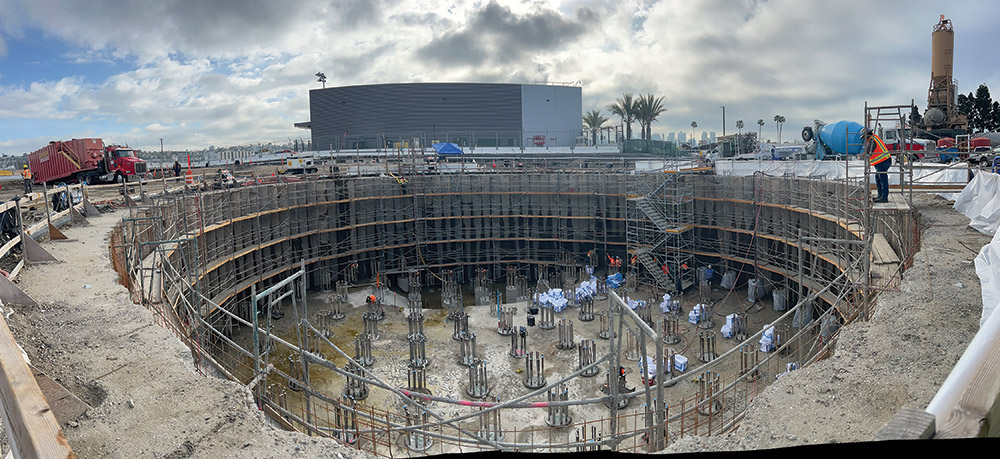
Crews conducted extensive utility work while dealing with shallow groundwater.
Photo courtesy Griffith Co.
Airfield Ambitions
The airfield improvements portion of the program includes a new taxiway and aircraft parking area, lighting and signage systems and an upgrade to one of the largest water capture-treatment-reuse systems at a U.S. airport, according to Jacobs, lead designer on improvements. This upgrade will reduce stormwater runoff into the bay by at least 80% and supplement water supply to the airport cooling towers, reducing potable water consumption.
“We have a 900,000-gallon cistern underneath the [overnight aircraft parking] apron,” says Karen Griffin, Jacobs senior aviation project manager. The cistern was originally designed for 1.5 million gallons, but was redesigned to be shallower due to the groundwater issues, while still meeting the 80% capture rate. It complements a 3-million-gallon cistern built a few years ago.
“All the stormwater is diverted to the cistern, and then to our central utility plant for filtration,” says Bolton. “Then the stormwater is returned to the airport for flushing urinals and toilets.”
Due to the unexpectedly heavy groundwater flow, the schedule fell behind by some 18 months in the first two years, notes Brad Olson, area manager with Griffith Co., which won the $250-million contract for the airfield work in 2021. Griffin adds that an endangered seabird habitat meant six months of no work near that area every year.
A partnering process with the airport and Jacobs resulted in significant rephasing, an accelerated schedule with overtime, and a $14-million change order. Now the project is several months ahead of the scheduled 2028 completion, says Olson.
Griffith crews placed 42,700 linear ft of utility pipe and 155,000 linear ft of electrical conduit and wiring, according to a company newsletter. Griffin adds that the work entailed 270,000 sq yd of portland cement pavement, 7,100 tons of surface asphalt, 102,500 tons of asphalt base and 186,000 cu yd of earthwork. Roughly 150,000 tons of crushed concrete was reused on site, says Olson. With the recycling, an onsite batch plant that reduced truck trips, and the cistern, among other features, the airfield design received an Envision Gold award.
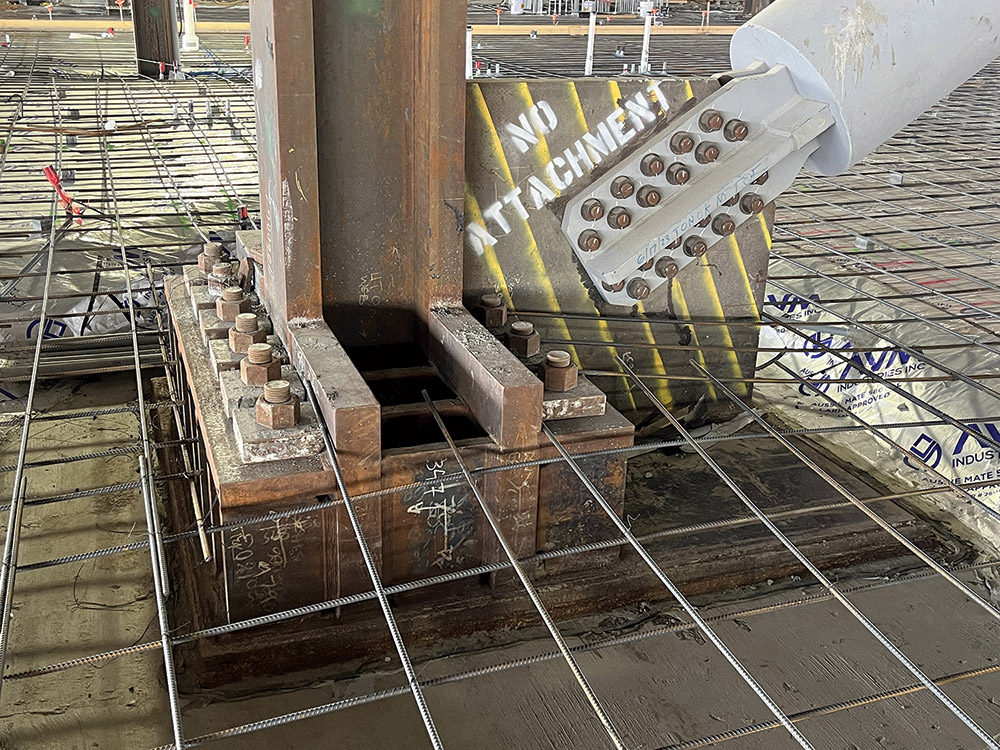
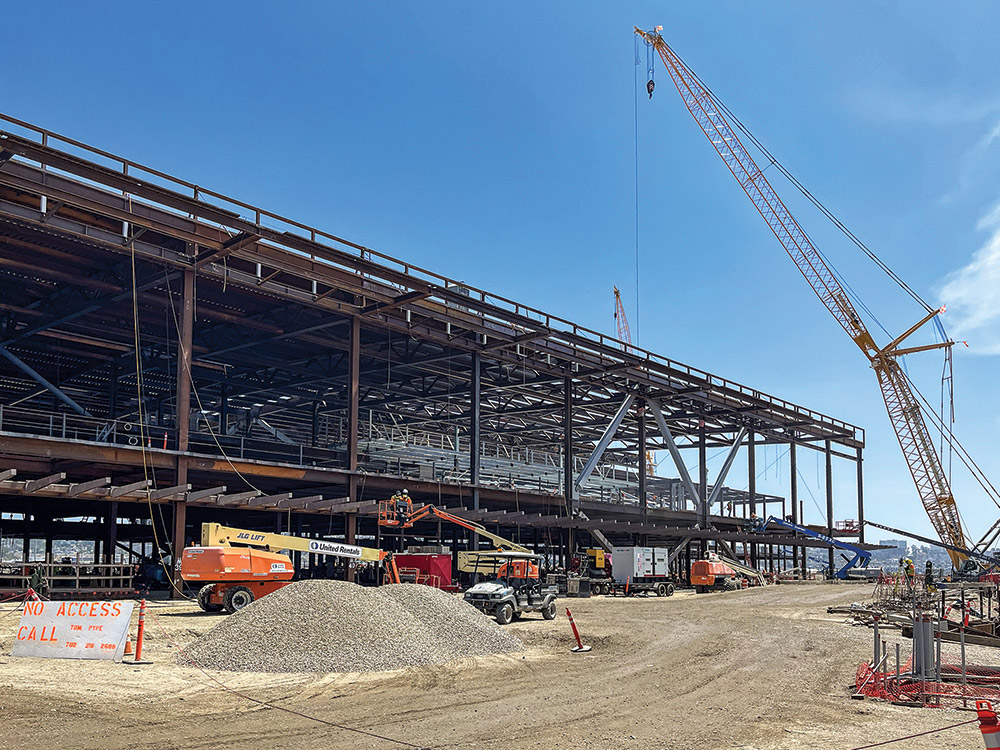
A Buckling Restrained Braced system provides seismic support and reduces the need for columns in the new terminal.
Photos courtesy Magnusson Klemencic Associates
Braced New World
Early in the design process, engineer Magnusson Klemencic Associates, consulting with the Gensler-led design team, leveraged steel’s ability to meet stringent seismic codes, blast requirements and strict vibration criteria. Switching to buckling restrained braces from a baseline steel moment frame lateral system allowed for elimination of about 100 columns, a 40% materials tonnage reduction and a 30% embodied carbon reduction, says Terry Palmer, MKA senior principal. “We were able to use those long-span trusses and long-span structure to get rid of all the intermediate columns in the ticketing hall.”
The BRB system consists of a steel core encased in a concrete-filled tube, preventing buckling while allowing symmetrical yielding in tension and compression. The terminal’s piles can transfer seismic shear through liquefiable soils to the stiffer soils below.
Steel fabricator/detailer/erector W&W | AFCO Steel worked with MKA to plan how the bracings would be installed and to shepherd the airport’s first-ever use of a BRB system through code approval. “We had two cranes on either side of the shortest width of the building, working simultaneously going down the length of the building,” says Toby Holt, W&W | AFCO senior vice president of project management. “This was a steel dead-load project. As the design evolved, we worked with Terry and MKA and looked at those break points and what one crane can reach from the other.”
The Liebherr LR1300s erected 9,600 tons of steel in 2023 between mid-April and November. The design incorporates two pedestrian bridges where Cast Connex castings replaced traditional bolted or welded gusset plates. These 100-ft structures, each comprising two Warren trusses, were prefabricated and lifted into place.
“The bridges were built on site and picked as one piece,” says Jaxon Nevins, senior project manager at W&W | AFCO. “We had a yard across the street where we would stage materials. The trusses went up quick.”
W&W | AFCO and MKA developed Tekla models early on, which helped inform steel connection details including BRB base connections. “The design was 30% to 50% at that point, so we were also able to get a lot of [steel] ordered way ahead of time. That helped a lot with the long lead-items,” Nevins says.
Most of the 238 BRBs were longer and larger than what had been physically tested by U.S. manufacturers. BRB core areas ranged from 4 sq in. to 50 sq in., with lengths exceeding 56 ft. BRB manufacturer CoreBrace had only qualified testing for core areas up to 24 sq in. at the time.
“[We] didn’t have the labs to test this size of seismic brace with its length and diameter,” says Palmer. “So you could test them up to a certain size, and you had to interpolate the data” using the American Institute of Steel Construction’s Seismic Provisions for Structural Steel Buildings.
The project team used nonlinear finite element analysis of the lengths calibrated to known test results. “There were some code-related extrapolations that had to occur, and some finite element analysis,” Holt says. The models included initial imperfections due to manufacturing tolerances, modeling of weld lines, and assessment of potential fracture at the core-to-connection-plate interfaces.
Two independent peer reviewers poured over the BRB modeling approach. The analysis established a new benchmark for BRB design and is informing the next version of the Seismic Provisions, according to AISC.
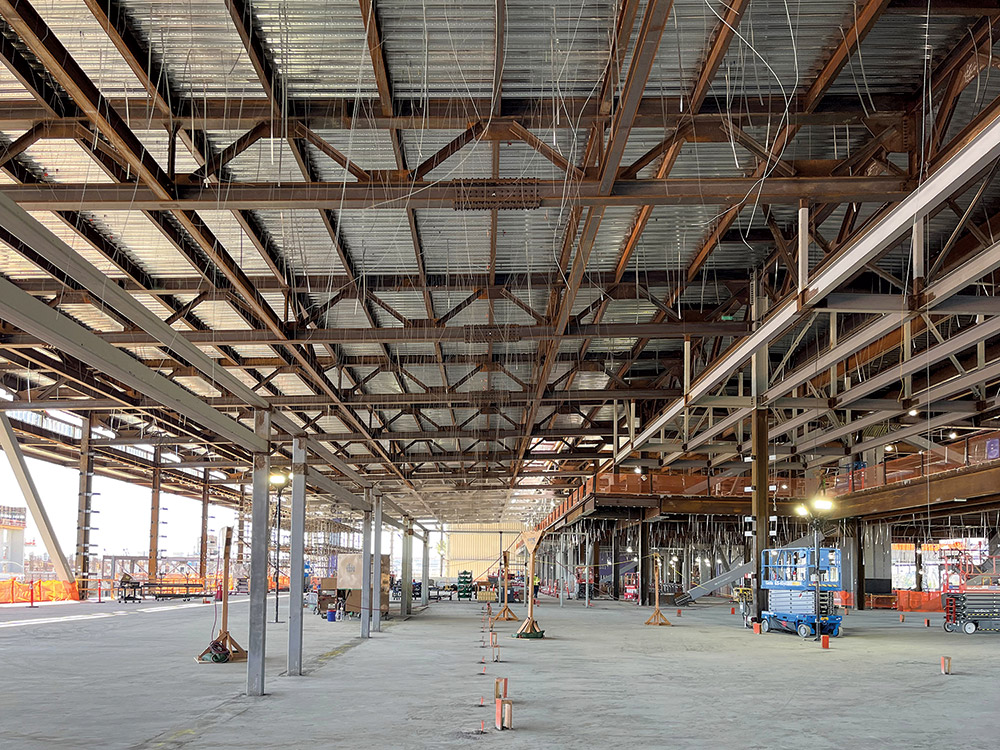
The New Terminal 1, at more than 1 million sq ft, is triple the size of the old terminal.
Photo courtesy Magnusson Klemencic Associates
Luminous Lighting
The headhouse’s facade faces due south, which meant that sunlight would potentially hit ticket agents head-on at certain times and heat up the space. Gensler worked with artist James Carpenter to design an 800-ft-long, 33-ft-high curved glass panel facade called Luminous Wave with 537 curved, fritted glass panels that mimic Pacific ocean waves and optimize the influx of sunshine.
“While a simple solution may have been to use a dark tinted glass, our design vision was to celebrate and connect with San Diego’s unique natural environment,” says Andy Huang, Gensler aviation studio director.
That design vision informs the rest of the terminal, with five art pieces placed within the terminal and two outside. The concession spaces are organized around themes reflecting various San Diego neighborhoods. “The design prioritized a Southern California feeling,” says Huang. “Materials, forms, and themes of everything from dining seating, ceiling design and floor patterns reflect a modern take on a SoCal seaside community.”
Modeling in 3D informed all aspects of the terminal, including canopies, architectural finishes, bathrooms, flooring details—not just for aesthetics but for durability, user-friendliness and futureproofing, according to Turner’s Stevens. The design team created a utility matrix for the concession spaces detailing the sizes of elements like waste vents, pipes and outlets so that future tenants know what they’ll be working with.
“During the interview and design phase, we had renderings of what the vision would look like,” Stevens says. “Every quarter, we compared renderings to [construction] reality. Every rendering, when matched with construction progress, was virtually identical.”
Frost adds: “One way that we conveyed our ideas [to stakeholders] during design was through visual simulation tools.” They were used to inform aspects such as lighting layout under the new departures bridge, signage and traffic management.
Revit modeling also informed the progressive design-build process as trade partners came on board, adds Stevens. On a regular basis, “we locked ourselves in a room with lots of burritos—the design team and their models, the trade partners and their models—and resolved every clash simultaneously.”
In the first phase, crews built a 9-acre roof, installed 10,000 light fixtures and added seven new baggage carousels. Overall, the terminal is aiming for LEED Silver. A 4-mile baggage handling system automatically stops if no bags are present, says Bolton. The approximately 1,200 motors “are smaller and more efficient” than before, and the system can handle up to 2,000 bags an hour. Passengers can drop off their bags at the “smart curb” of the new terminal.
The design theme extends to the $325-million, 1-million-sq-ft, 5,221-space parking garage. As with a previous structure built for Terminal 2, it’s called a “parking plaza” to reflect its role in the passenger experience, says Huang. To satisfy California Coastal Commission aesthetic requirements, since the parking garage can be seen from the bay, “the facade features a series of vertical fins that subtly shift, creating a wavelike pattern that mimics but doesn’t copy the Luminous Wave,” he says.
The structure features three light wells, intuitive wayfinding, a smart parking system, EV chargers and speed ramps that connect directly to plaza floors. Swinerton, working with Gensler and Watry Design on the design-build project, opened the first phase of the five-story structure with almost 3,000 spaces in 2024, and the rest last year. As with T1, the phases were necessary to accommodate other construction occurring in the tight space.
A lesson learned from building the parking plaza for Green Build was to place concrete “in the wee hours of the morning,” says Jeffrey Goodermote, Swinerton vice president. “We had more consistent and predictable weather,” leading to better quality control.
“For us, it was a reunion from [Green Build], as Watry and Gensler remained as the [designers] for this parking plaza,” he adds. The plaza received a ParkSmart Gold certification.
Once the first phase opened, Turner-FlatironDragados workers could park there instead of being bused as far as 1.5 miles, with stops, to the T1 site, notes Costa. Until then, “as a contractor, we also became a transportation company,” he says.
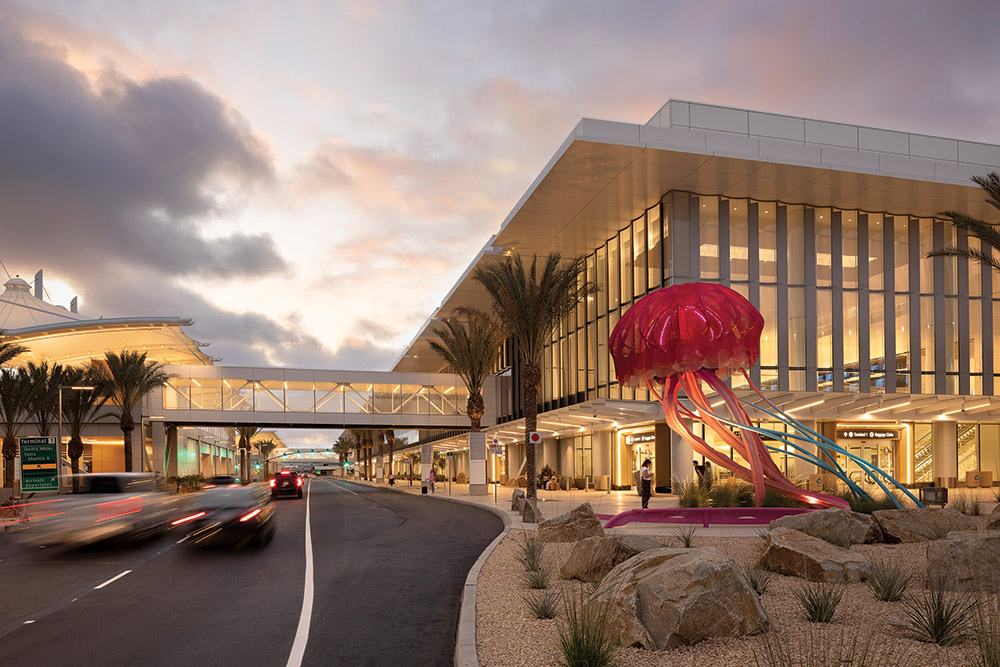
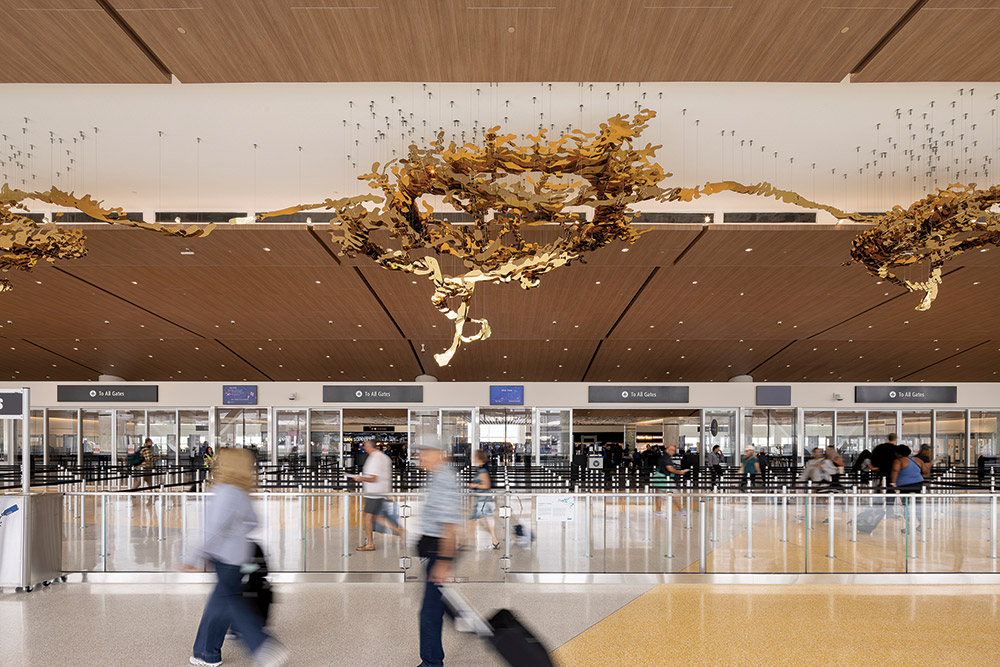
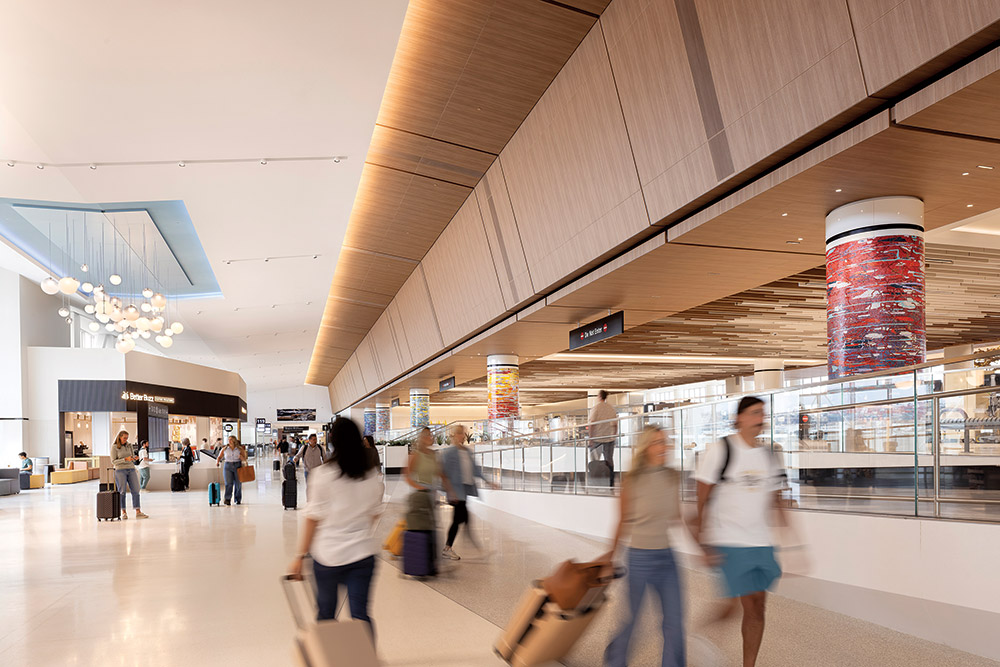
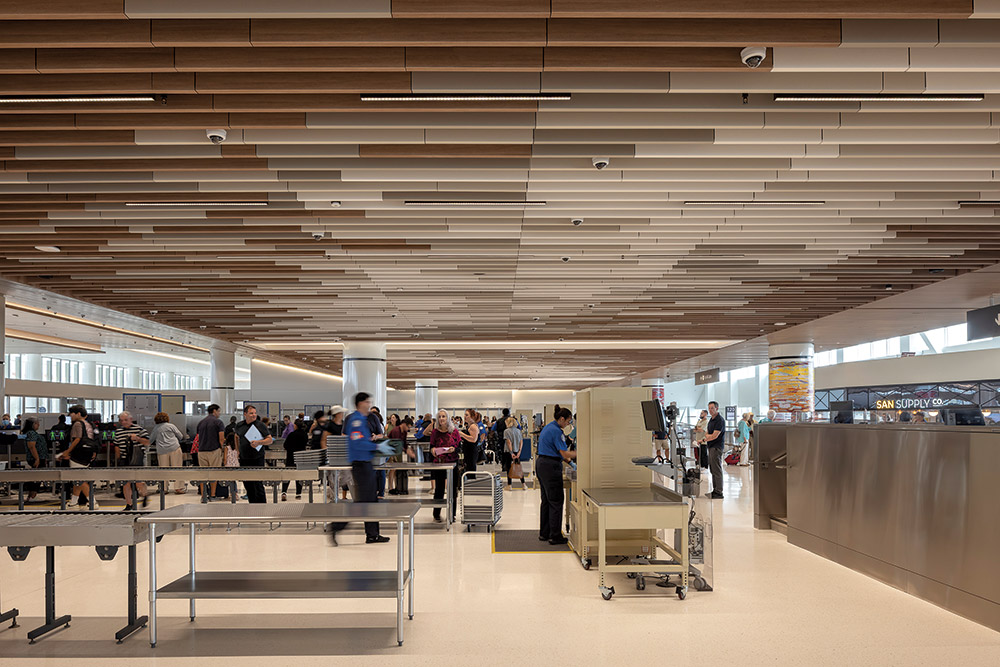
The LEED-certified terminal features extensive artwork and a headhouse wall created by Gensler and artist James Carpenter with fritted glass panels that reduce heat and glare while creating a ripple pattern.
Images courtesy Ema Peter
On the Horizon
Another ongoing revamp at SAN addresses the use of PMWEB and other project management information tools, says Mike Carmichael, SAN’s project manager for controls. Until he came on board two years ago, the IT department was not collaborating with construction or accounting personnel, he says. “I conducted a summit to get everyone into a room for two days.”
The revamp of the system—and the training for its users—enabled a “strategic control center” that “keeps every process on time, stakeholders connected and every dollar accounted for,” says Chris Wagner, PMWEB vice president of industry strategy.
SAN plans to roll out a cloud-based upgrade to the project management information system over the coming months. While the improvements so far have cut invoice cycle times by half, “we’re absolutely looking to make it even better” for that and other operations such as processing RFIs and submittals in an integrated environment, says Carmichael. “Our implementation will benefit phase two … in getting things closed out and not taking years to get final billings done, as-builts done, schedules done.”
AECOM and SAN recently completed and are now in the validation phase for a program definition document regarding the next big capital project, T2 East, says AECOM’s McCabe. It will entail an approximately 600-ft-long, 20-ft-wide connector between Terminals 1 and 2 that will include two gates. The two terminals currently do not have a post-security connection.
The team led by Sundt Construction and HOK will also renovate the headhouse and northernmost gates of T2. “Right now we are evaluating both stick-build and a remote modular option” for the work, says McCabe. “We are just starting to sink our teeth into it.”
The post "San Diego International Airport Aims High Structurally, Sustainably and Aesthetically" appeared first on Consulting-Specifying Engineer