

Port of Long Beach Continues $2.4B Buildout as the Bigger Ships Come In
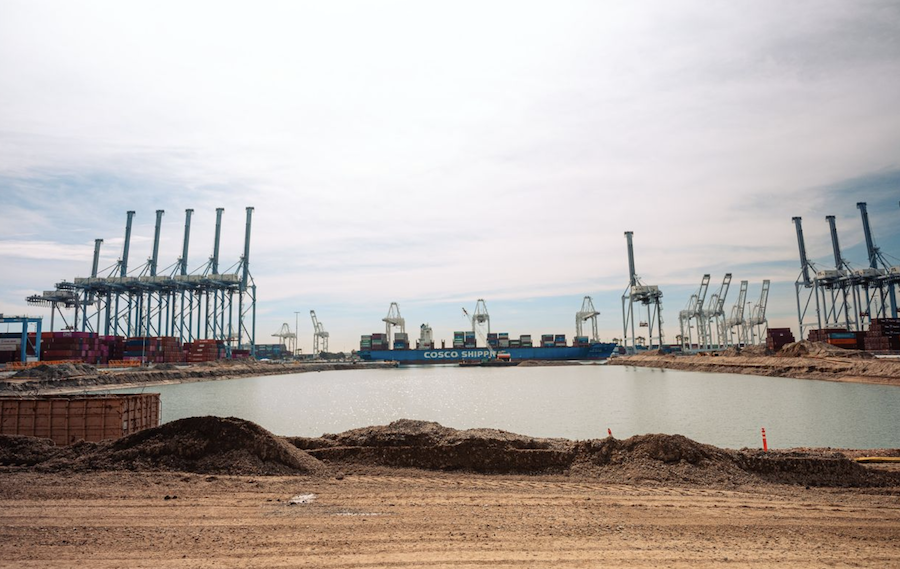
The Port of Long Beach continues to invest $2.4 billion over the next decade in its capital program, building out on-dock rail capacity, upgrading harbor structures, and preparing for a planned dredging effort.
One of the port’s tenants is pitching in by funding a nearly $400 million effort to fill in an unused south slip to create 19 acres of new land, while building a 3,400-foot continuous wharf to host mega-container ships—a massive demolition, excavation and eventually concrete paving job that takes place right in the center of shipping activities at the nation’s second-largest seaport.
When the Pier G south slip fill project is complete in late 2027, the terminal will have three continuous berths totaling 3,400 ft. “That will give us better operational flexibility. It will enable us to handle simultaneously two of the largest container ships in the world, which we can’t do today with our current wharves,” says Halfton Ross, chief project officer with International Transportation Service. “Filling up this slip is going to increase our capacity much more than just the physical land. It will optimize our traffic arrangement, our traffic flow.”
While the project only adds about 19 acres to the port’s 256 total acres, it’s about how it affects its broader logistics, says Ross. “[That 19 acre lot] it not even 10% of additional land, but it has the potential to increase our overall terminal capacity by up to 50 percent.”
The ITS terminal currently handles about 1 million 20-ft equivalent unit (TEU) containers. The Port of Long Beach has said that by 2050 it will need to increase its overall capacity by 100%.
“That’s going to be difficult to do under existing constraints,” says Darren Lamberger, former director of construction management for the port. He is now Southern California construction management and field services leader for HDR, which leads design of the port’s $1.5-billion Pier B on-dock rail facility. “One of the ways we do that is by bringing bigger ships in. As we’ve been growing, we’re filling these smaller slips to make larger wharves, to bring in larger ships which have much greater capacity, larger cranes, and quicker movement of cargo.”
Pier Infill Underway
A joint venture of Griffith Co. and The Dutra Group won a $358-million contract in 2025 from ITS to build the Pier G Infill project, with Griffith handling landside and Dutra waterside. “Originally it came in at a higher value, but through value engineering and working closely with our customer, we were able to value engineer it down,” says Ryan Aukerman, president of Griffith. “We came in and demolished the old wharf that went around this [horseshoe-shaped] slip and that’s going to allow us to fill in the water portion with rock dike, armor stone and new piles.”
The demolition of 3,000 linear ft of wharf included removal and recycling of 1,500 tons of steel and 40,000 cu yd of concrete. It also included 10,342 cu yd of crushed miscellaneous base, 19,000 cu yd of asphalt, 15,000 cu yd of concrete and 28,319 cu yd of earth from landside infrastructure such as berths. Some 2.5 million cu yd of material from within the complex and from Newport Beach will help fill in the south slip.
Last year, crews began installing underground facilities such as storm drains and bioretention filters, Aukerman adds. Then they began grading out backlands to put back into service while continuing to fill in the slip. “After all the rock dike is in at the right level, we’ll bring in dirt to surcharge and let it settle for six months.”
The dike includes some 487,000 tons of rock, 1,792,500 cu yd of dredged fill and will use some 485,000 cu yd of material for the surcharge, with some 5.4 million linear ft of wick drains. “One of the biggest challenges is the electrical requirement for dredging,” says Brian O’Sullivan, COO of The Dutra Group. “We had to build a new crane to be able to do that. We’ve got tugboats, we’ve got our full ‘Morty’ [1,054-gross-ton] barge out there with the [Lieber 8300] electric crane on it.”
Crews will drive some 381 piles as long as 105 ft to support the new wharf and its 560-ft extension, which will utilize 8,300 cu yd of concrete and some 3 million lb of steel. Completion is slated for late 2027.
Crews will install thousands of linear ft of various new utilities, including 75 storm drain structures and five storm treatment units. Major ones include a 72-in.-dia outfall pipe around 1,900 ft long and a 48-in.-pipe around 1,400 ft long. “We were running both lines simultaneously so whenever we had a high tide on one side, luckily for us on the 48- inch side it wasn’t as bad as on the a 72-inch side,” says Luis Baeza, the joint venture’s underground field superintendent.
Paving operations will include a section of 17-in.-thick cement-treated base, with an 11-in. section for the “backlands” storage and staging area behind the wharf. “Then we’ll be putting seven inches of paving over the top” of the base, says Joe Caratini, a project superintendent with Griffith. “We’re going to have an on-site batch plant for our cement treated base. Once surcharging is complete, “we’ll start spreading out our base, and then we’ll set up a pug mill. And once they start mixing and we get our grading done, we’ll start importing that base and bringing it up front and making our grade.” The approximate dimension of the paving area is 20 acres, he adds.
The team is utilizing three proprietary devices to treat water and capture runoff: PerkFilters, a three-chamber system with cartridges that remove solids, debris and pollutants; a high-flow biopod stormwater treatment system; and CDS units, a hydrodynamic separator that captures trash, debris, sediment and oil or grease from stormwater runoff using a continuous deflective separation with an integrated oil baffle, says Mercy Canul, underground division project manager. “We will be installing four different systems with 16 manholes” for the biopods, she says, adding that the team is installing 10 PerkFilters and 13 CDS units.
Working With Tides and Traffic
The biggest challenge so far has been the unknowns,” says Matthew Arroyo, Griffith project manager. “On this project that was evident when we started digging our storm drain line and we discovered an unexploded ordinance.” Unexploded ordinance was found in 2025, followed by a spent shell casing this February. “Once we found the ordinance, we had to contact the proper authorities to really understand what it was and understand the impact that it could have on the job,” says Arroyo. Experts have been guiding the team on protocols for dealing with the risk.
Somewhat more predictable of a risk are the tides, which fluctuations affect operations such as installing pipe. The team reviews tide charts daily to adjust work activities accordingly. “As the weeks go by, you really monitor the different tide tables and you’re able to kind of plan work where you know you can do it, and you have fallback work that you can go with when you can’t,” says Arroyo. Crews still have to deal with unpredictable winds, busy marine traffic, and busy terminal traffic.
The team works closely with ITS on site access and devising ways to save or tweak schedules. “Having a construction site in the middle of an operating container terminal is not ideal for any parties,” says Ross. “We handle up to 3,000 container trucks a day, so we don’t need a lot of extra roadside traffic. The [original] intention was to bring everything in waterside, but that’s also complicated, takes more time and potentially also costs more. So we worked with our contractors on finding windows. When can they come in with the deliveries, let’s say for example all the piles, instead of bringing them by barge, we allow them to come in on flatbed trucks. We work with them on what time of the day it won’t interfere with our operations.”
“Given the heavier equipment and the port having the right-of-way, that’s always tough, especially when you’re trying to meet project demands,” says Danny Cortez, corporate safety manager with Griffith. “We really try to coordinate those efforts out ahead of time. One simple way is just using flaggers with two-way radio communication.”
Arroyo also notes one upside to working within a busy container terminal. “We’re fortunate enough to have a project that gives us a secure jobsite with K-rail and fencing,” he says. “ The port is a secure place where you know we don’t have to deal with some of the typical challenges of a construction site.”
The post "Port of Long Beach Continues $2.4B Buildout as the Bigger Ships Come In" appeared first on Consulting-Specifying Engineer