


States, Cities Continue Push for Decarbonization, Emissions Reductions, Despite Trump Opposition
Despite ongoing Trump administration efforts to spur a resurgence in fossil fuel development, many state officials, along with government leaders across the globe are moving in the opposite direction, as they continue to advance programs and projects that would reduce greenhouse gas emissions.
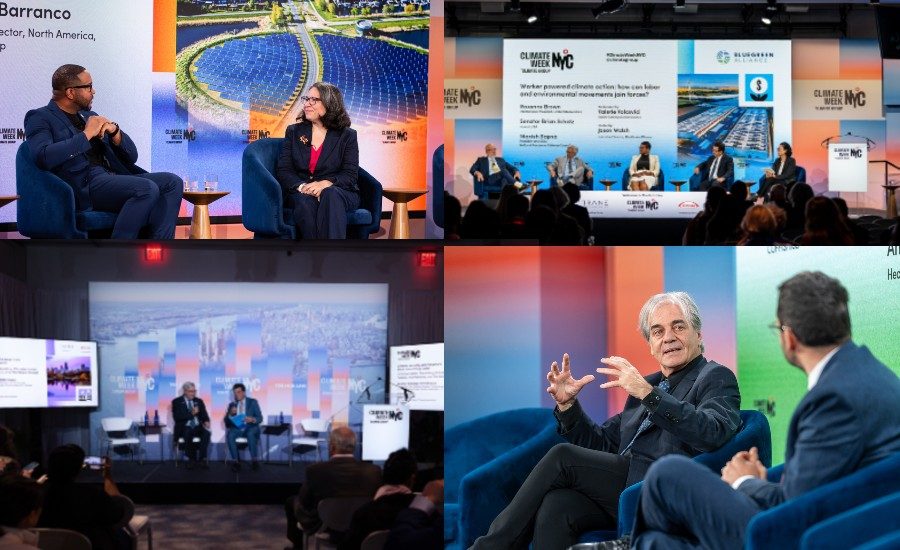
The need has never been greater. Current climate modeling has underestimated future warming, said Phil Duffy, who served in the White House Office of Science and Technology Policy during the Biden administration. “My mind goes toward something called derailment risk, which is the idea that compounding climate events can consume so much energy and so much attention that it becomes impossible to take the steps we need to take to address the underlying drivers of risk,” said Duffy, now chief scientist at nonprofit Spark Climate Solutions, during a Sept. 22 panel at the annual Climate Week conference in New York City.
Timed each year to coincide with the September United Nations General Assembly meetings in New York City, the event shares some of the General Assembly’s international focus alongside local and national concerns.
This year’s sessions and announcements demonstrated how localities, cities, and regions are expanding their agency when it comes to climate response, including pooling resources and building alliances. “Over recent years we’ve seen the state and regional governments … getting a growing recognition internationally as climate leaders,” said Andrew Forth, Climate Group head of policy and advocacy.
On Sept. 22, the U.S. Climate Alliance, a bipartisan coalition of 24 governors across the U.S., announced a partnership with Climate Mayors, a group of more than 350 mayors across 47 states committed to advancing climate action.
State officials noted that despite headwinds from the administration, U.S. states and cities are still moving forward with plans and projects to reduce greenhouse gas emissions, and that they still retain significant authority to do so.
Among the goals of the collaboration are sharing resources to accelerate the deployment of clean energy, reducing greenhouse gas emissions consistent with the goals of the Paris Agreement, and building resilience against climate change impacts.
Alliance co-chair and Washington Governor Bob Ferguson (D) said, “Together, we are a force. By working together, we can continue to make meaningful progress on climate, clean energy, electrification, and more.”
On Sept. 23, California Gov Gavin Newsom (D) and Ferguson announced that Washington had reached a milestone in updating its regulatory framework, allowing the state to link in to the California–Québec carbon market in 2027. Together, these three jurisdictions would rank as the third-largest economy in the world.
The California-Quebec carbon market has generated $13 billion since its inception, said Jean Lemire, Quebec envoy for climate change and northern and arctic affairs, in separate session. “[It] put a price on pollution. That’s the key,” he said. “With the geopolitical situation, we will not have a lot of money if we don’t find a way auto-finance what we do,” he added. One of the key uses for that money is helping business bridge expenses relation to electrification.
The Under2Coalition, which now counts more than 187 local governments, states, regions and other “subnational governments” among its members working toward achieving net-zero carbon emissions by 2050, represents 1/8 of the world’s population and more than half its GDP. “In many places in the world it’s the subnational governments that have the competencies, the laws … we have to be around the table,” said Lemire, adding that the coalition demonstrates that subnational governments have “real influence that will continue.” The coalition also announced a partnership with Climate Policy Radar, which creates databases and other searchable information on climate law and legislation, to allow effective laws and policies to be shared, such as carbon markets.
‘The Transition to Net-zero Is a Construction Project’
On a panel focused on sustainable materials, particularly less carbon-intensive concrete and steel, Lisa Kaufman, a senior manager with Climate Group told attendees: “Essentially, the transition to net-zero is a construction project. The climate resilient cities of tomorrow, the sea walls protecting our coasts, the transmission networks connecting clean power, all depend on steel and concrete. That’s why low-emission steel and concrete must sit at the heart of this transition.”
On the same panel, Mariane Jang, senior policy advisor, resilience and sustainability in New York State’s Office of General Services, noted a 2022 executive order from Gov. Kathy Hochul (D) which mandated state agencies must reduce the embodied carbon in their construction materials. “That’s where the opportunity for us is as a policy driver,” she said.
Since Hochul signed Executive Order 22, the state has issued several sets of guidelines to state agencies on how to reduce embodied carbon levels in materials, Jang said, but added that although the state is “very motivated and very driven,” general awareness about the topic across sectors and all the way down the value chain would help scale the use of less carbon-intensive materials.
The Climate Group launched its Blend Better Cement campaign earlier this year, calling on governments to switch to less carbon-intensive blended cement, which relies on supplementary cementitious materials (SCM) such as calcined clay or limestone. The campaign advocates for supportive policies like updated building codes, and works with the industry to increase the supply and access to SCMs, prioritizing its use in public projects.
“Working people need to be at the center of climate policy and energy transition, or we will be back where we started with solutions that won’t work and don’t,” argued Jason Walsh, executive director of environmental and labor coalition BlueGreen Alliance, in a session on how workers and environmentalist can work together in pursuit of climate goals. Walsh anticipates the return of climate legislation that will merge emissions-reduction goals with investment and worker benefits.
One area where those goals work in tandem is in modernizing and decarbonizing ports, said USW International President and BGA Co-Chair Roxanne Brown. “Labor and environmentalists can work together to make sure that we are sourcing our port infrastructure here in the United States and building out that infrastructure for the future.”
“The political aperture for climate change has never been so wide open,” said Sen. Brian Schatz (D-Hawaii). “We get to say the cheapest thing also aligns with our labor priority. The cheapest thing for you also aligns with solving the planetary crisis.”
While still recovering from a storm that “set us back two years from the progress we were making,” Gary, Ind., Mayor Eddie Melton is preparing for a recovery that will harden infrastructure in anticipation of future migration influenced by climate change, he said in an interview. “[The] Midwest is going to be a key area where folks are going to be moving from around the country because of the largest freshest body of water in the Lake Michigan area, so we have to protect that asset,” while also balancing needs of surrounding industry and infrastructure, including construction of a new convention center and plans for a downtown rail station to make the area more walkable.
Gary has started to “bridge the gap” in the relationship between the city and U.S. Steel partner Nippon Steel, “advocating for a green steel making process that’s more energy efficient, cleaner, because we know the steelmaking process is something we need as a nation.”
The post "States, Cities Continue Push for Decarbonization, Emissions Reductions, Despite Trump Opposition" appeared first on Consulting-Specifying Engineer