


The roof replacement a science centre did not need
Told that its leaking gallery roof needed a full strip and replacement, We The Curious asked for evidence before committing the capital. What core sampling and independent moisture mapping found changed the scope, the cost, and the experience of the visitors, school groups, and community organisations who use the Bristol science centre every day. This article looks at how a survey-led approach kept the building open, and at the questions any estates team can ask before replacing a roof.
Visitors, school groups, and community organisations kept using We The Curious while its North Gallery roof was refurbished overhead. The roof now loses less heat, the building costs less to run, and the charity spent an estimated £64,000 less than a full replacement would have cost. That outcome came from the estates team asking for evidence of what the roof needed before they committed the capital.
A recommendation worth testing
The North Gallery roof had been leaking. Membranes had become brittle, seams had failed, and the detailing around critical junctions had deteriorated. An earlier assessment had recommended a full strip and replacement.
As an educational charity working with finite capital, We The Curious could not justify that spend unless it was genuinely necessary. The recommendation needed scrutiny rather than straightforward acceptance, so the team asked Garland UK Technical Manager Justyn Irons to look at the roof again.
Measuring what is left in a roof
A visual inspection shows the condition of the surface, but not how far water has travelled into the build-up beneath it. That is what decides whether a roof has to come off or can be kept.
Justyn carried out a detailed roof condition survey with core sampling. Separately, Rob Simpson of RWS Consultants carried out independent moisture mapping using a nuclear moisture gauge. Between them, the two investigations showed that the gutter section was saturated, while the majority of the existing build-up remained serviceable. The estates team now had evidence from two sources on which to base a capital decision.
Replacing only what had failed
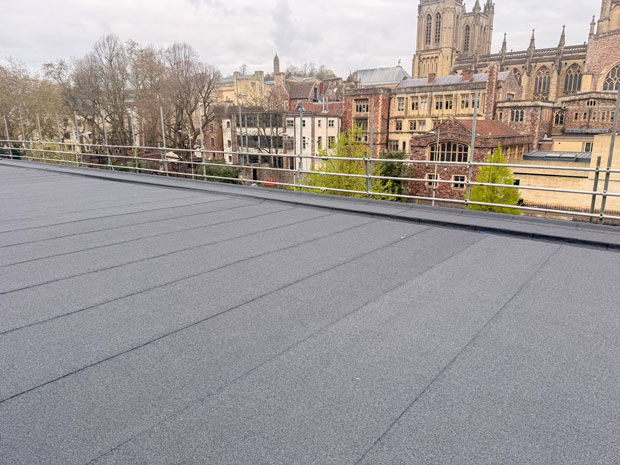
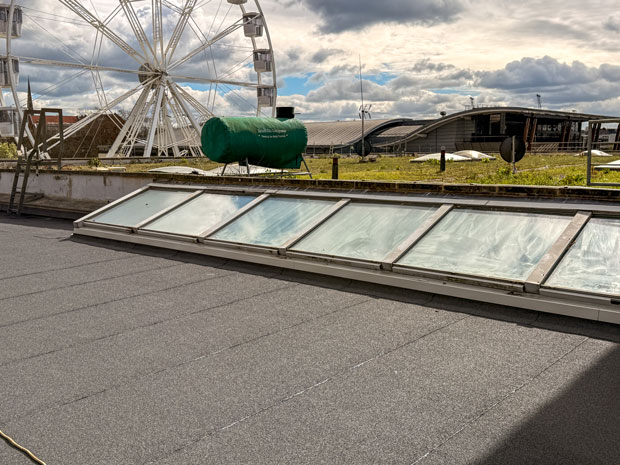
With the problem measured, the scope of work could be matched to it. Justyn specified the StressPly Flex Plus waterproofing system. The saturated gutter section was stripped back and rebuilt, and the remaining roof areas were retained and overlaid.
A new insulated overlay improved the roof’s U-value from 0.23 W/m²K to 0.18 W/m²K, bringing it up to current regulatory standards. The building now loses less heat through the roof, which reduces running costs for an organisation that benefits from keeping them down.
Approved Contractor TRS Roofing installed the roof, with Justyn providing technical support, quality assurance inspections, and project oversight throughout. He visited the site weekly and recorded each stage in RAMP, Garland UK’s cloud-based Roof Asset Management Programme, so the estates team knew what was happening on the roof without chasing anyone for an update.
What the charity gained
The survey-led approach saved We The Curious an estimated £64,000 compared with the original recommendation. Keeping serviceable materials in place also prevented approximately 32 tonnes of waste from going to landfill.
The North Gallery now carries a 25 year Single-Point Guarantee covering design, materials, and installation workmanship, with one accountable provider. For a charity managing its assets on a restricted budget, that means no unexpected repair bills during the guarantee period and no dispute over liability if an issue arises.
Jen Field, Head of Estates at We The Curious, said, “The independent survey findings gave us clear evidence of what the roof actually needed, allowing us to avoid unnecessary replacement works and focus investment where it would deliver the greatest value.”
Questions to ask before replacing a roof
The same approach applies to any estate. When a roof is recommended for replacement, start by asking what the recommendation is based on. If the answer is a visual inspection, the condition beneath the surface is an assumption rather than a finding.
Ask whether moisture has been measured across the whole roof, and whether cores have been taken to confirm the readings. Ask whether any areas can be retained, and what that would mean for cost, for waste, and for the people using the building while the work goes on. Then ask who will be accountable for design, materials, and workmanship once the contractor has left the site.
A full replacement is sometimes the right answer, and these questions make sure it is chosen on evidence. Our position at Garland UK is that we will tell you if the work isn’t needed, even if it costs us the job.
Justyn Irons, Technical Manager at Garland UK, said, “Too often, building owners face major capital expenditure decisions without a clear picture of what the existing asset actually needs. Independent investigation changes that. Here, it proved a full replacement wasn’t necessary and allowed us to develop a solution based on evidence rather than assumption.”
Find out what your roof needs
A Free Roof Survey from Garland UK is carried out by your local Technical Manager. It includes a roof lifespan assessment, defects analysis, U-value calculations, core sampling, and moisture mapping, with a written report and photographic evidence. Book yours at garlanduk.com/services/free-commercial-roof-survey
The post The roof replacement a science centre did not need appeared first on FMJ.