


World’s Longest Immersed Tunnel Passes Milestone, But Faces Delays
Work on the $8-billion Fehmarnbelt Tunnel, which is planned to link Germany and Denmark as the world’s longest immersed tunnel, is progressing as crews achieved a milestone last month with the successful immersion of its first precast concrete element. But Danish state-owned project owner Femern A/S says the plan is now running at least two years behind schedule and the tunnel’s road and rail portions will open in two separate stages.
The nearly-11-mile-long, five-tube tunnel would cross 140 ft below the Baltic Sea between Puttgarden in northern Germany and Lolland Island in southeast Denmark. With four road lanes and two electrified rail lines plus an access passage in a dredged trench, it would provide a critical new artery connecting Scandinavia to central Europe, with an estimated travel time of seven minutes by train or 10 minutes by car and would cut in half the five-hour rail journey between Hamburg and Copenhagen.
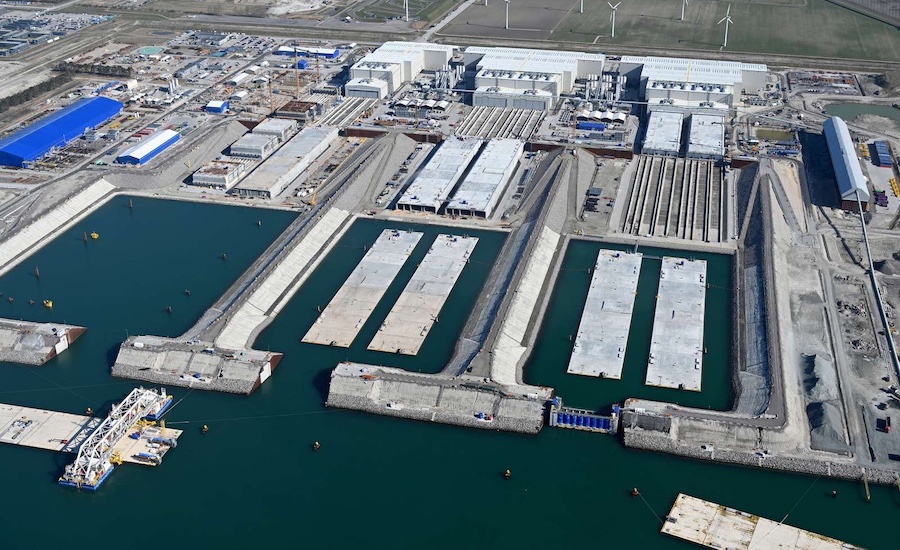
Femern Link Contractors (FLC), a joint venture led by Vinci Grands Projets SAS, has been pre-casting the 79 standard 712-ft-long, 138-ft-wide, 30-ft-tall concrete tunnel elements, each weighing 73,500 metric tons, plus 10 others with housing for electrical elements, so they can be towed by tugboat and submerged into place in the dredged trench.
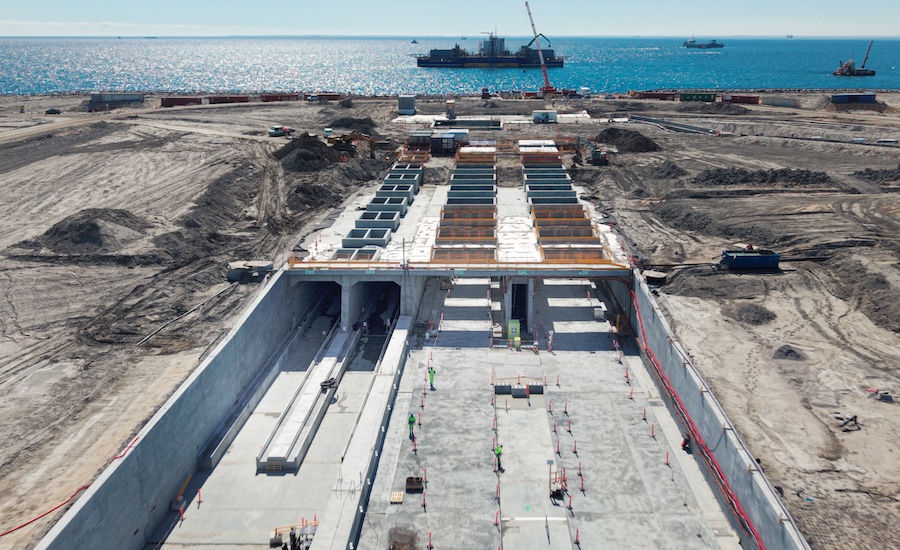
Dredging of the 260-ft-wide, 33-ft-deep trench was performed by a separate consortium, Fehmarn Belt Contractors, led by Royal Boskalis Westminster NV and Van Oord NV. About 60 vessels were involved in excavating 530 million cu ft of material. Dredging began in 2020 and completed in 2024. Excavated material is being reused to create more than 700 acres of land for nature and recreation.
Equipment Issues Force Delays
Construction is proceeding simultaneously on both sides of the strait with a plan of eventually meeting in the middle, but work on the Danish side is currently about two years behind schedule due to issues with a vessel used to immerse the tunnel elements, according to Femern, the project owner. The tunnel had originally been scheduled to open in 2029.
Additional issues are also affecting the schedule on the German side. Last summer, German transportation officials announced that the country’s approval and permit process would not allow for railway facilities associated with the tunnel to enter operation in 2029. Germany’s limits on underwater noise in its waters are further impacting the schedule and will make it difficult to recover lost time, according to Femern and its parent company, Sund & Baelt. They plan to issue an updated schedule once several tunnel elements have been immersed.
Due to the delays, the road portion of the tunnel will now open ahead of the rail portion, according to Femern.
“A phased opening makes it possible to put the tunnel into use earlier for road traffic, while also reducing complexity in the final stage of the project,” Sund & Baelt CEO Mikkel Hemmingsen said in a statement.
Delaying the electrified railroad portion later than the road “is unfortunate for the green transition and for rail passengers,” he added.
Project Still Advancing
Despite the issues, work on the Fehmarnbelt Tunnel has been advancing, with thousands of workers involved, according to Femern. FLC opened a production facility in Rodbyhavn, Denmark, to pre-cast the concrete tunnel elements. More than 2,000 people are working on six production lines at the Rodbyhavn plant, while about 100 others are producing steel lattice reinforcing bar components at another facility nearby.
Photo courtesy Femern A/S
On May 4, five tugboats began towing the contractor’s specialized immersion pontoons IVY 1 and IVY 2 with the first tunnel element. They traveled just over a mile to the Danish side portal.
The immersion itself began on May 6 and took about 14 hours, according to Femern. Using hydraulic arms, crews then connected the precast element to the tunnel portal. Another vessel then placed gravel locking fill on both sides of the element to secure it in place.
“We are both happy and relieved,” Hemmingsen said in a statement on the successful immersion. “Our technology, our equipment and our contractors have demonstrated their capabilities and achieved something no one has done before.”
The post "World's Longest Immersed Tunnel Passes Milestone, But Faces Delays" appeared first on Consulting-Specifying Engineer